there is something absurd about the amount of human effort that goes into understanding things. years spent investigating a mathematical problem. entire careers devoted to the behaviour of a particular material. people trying to establish what happens inside a cell, why a star behaves the way it does, or whether a problem that has resisted solution for decades can finally be solved. most of us will never encounter the results of this work in any detail. we will, however, live with its consequences.
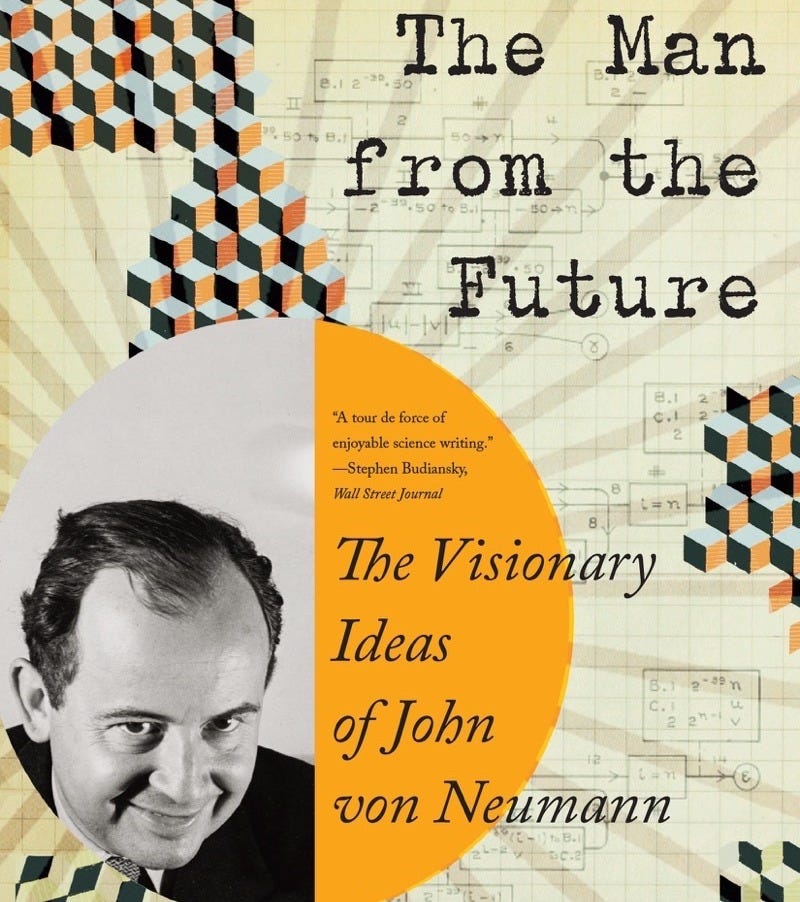
i recently finished ananyo bhattacharya’s the man from the future, about john von neumann, and found myself thinking about the disposition that makes a life like his possible. von neumann had an extraordinary capacity for mathematics, but what interests me is the apparent pleasure he took in seeing what mathematical thinking could do elsewhere. he moved between disciplines with an appetite for their possibilities.
i wonder how much of civilisation is the accumulated consequence of this disposition - the inability to be entirely satisfied with what one already knows. we have a peculiar relationship with this impulse. we admire its results, often without having much patience for the process. we want the finished theory, the functioning machine, the elegant proof. the years of concentration required to produce them are another matter. even the word obsession tends to acquire its flattering meaning retrospectively, after the obsessed person has given us something worth admiring.
but i am not sure the outcome is the point.
there is something valuable about wanting to understand a thing for its own sake, even if the understanding never becomes useful to anyone else. a person could spend years pursuing a question and die without resolving it. the world might never know they had tried. i struggle to see why this should make the pursuit less worthy. we have made usefulness such a dominant measure of human activity that we sometimes forget the pleasure of understanding something simply because it exists and we do not yet understand it.
perhaps this is partly why our present abundance of information interests me. knowledge has never been easier to access. i can ask an AI to explain a chemical reaction, the structure of a computer, or some obscure historical event and receive a serviceable answer almost immediately. this is an extraordinary convenience. yet i wonder whether the knowledge that an answer is always within reach has made us less likely to develop the appetite that would lead us to seek it.
there is a difference between wanting an answer and wanting to know. the former can be satisfied in seconds. the latter can occupy a life.
i might never have asked why a particular material behaves as it does if the question had not first bothered me. but once the question becomes interesting enough, the answer is rarely the end of it. one explanation leads to another question, which leads somewhere else entirely. an inquiry develops a life of its own. i suspect this is how many obsessions begin - a small refusal to leave something unexplained.
we cannot all be von neumann, nor should we need to be. most obsessions will not yield discoveries, and most people have more immediate concerns than investigating the world. there is no virtue in pretending otherwise. but i do think we ought to be careful about a life in which almost everything is encountered at the level of its finished form. the song without any interest in how it works. the technology without any curiosity about its construction. the natural world as scenery, rather than something whose existence presents an inexhaustible set of questions.
we inherit the world as though it were inevitable. it isn’t. much of what seems ordinary to us was once uncertain, difficult, or not yet imagined. somebody had to care enough to find out.
i find that worth remembering, because there is a particular pleasure in being interested in the world beyond what it can immediately offer us. the people who change things will continue to do so. i am more interested in whether the rest of us can recover some of the appetite that makes such change possible.
there is, after all, a great deal here we have yet to understand.